Learn the difference between value betting and chasing locks. Discover the mathematical edge professional sharps use to beat the house.
The Surface Tension
The public’s obsession with “Locks” stems from a fundamental misunderstanding of probability and risk, fueled by emotional narratives and headline-driven perceptions. The term “Lock” itself resonates with an alluring promise, a façade of assured victory that plays into the psychological biases of the recreational gambler. This belief in a “sure thing” is often magnified by media narratives that sensationalize certain matchups, framing them as David versus Goliath battles where the outcome seems predestined. However, this is where the sharp bettor sees the misstep. The variance inherent in sports outcomes is a reality that the general public often overlooks, seduced by the allure of certainty. This collective delusion creates market inefficiencies, as bettors ignore the implied probabilities embedded in the odds, fixating instead on the presumed outcome. According to a study by the American Gaming Association, over 45% of bettors admitted to placing wagers based on gut feeling rather than statistical analysis. This emotional tilt is precisely what creates opportunities for the sharp bettor, who is not swayed by the crowd’s emotional highs and lows. Instead, the professional is calculating probabilities, assessing risk, and exploiting the gaps left by those who chase the illusion of a “Lock.” These crowd-driven misconceptions offer a fertile ground for extracting value, as the public’s emotional investment in narratives often distorts the odds, creating a discrepancy between perceived likelihood and mathematical probability.
The Institutional Undercurrent
In the undercurrent of the betting world, structural pressure and institutional positioning create a complex web where sharp money thrives on inefficiencies. The sharp money isn’t following the noise of public sentiment; it’s quietly exploiting the mispriced odds that arise from it. Institutional bettors, those who operate with large bankrolls, understand that sportsbooks adjust their lines not just for accuracy but to balance their books against public money. This creates opportunities for the astute bettor who understands that line movements are not always reflective of true probability shifts but rather of public perception. For instance, a team might be overvalued due to recent high-profile wins that swayed public opinion, while sharp money identifies an inflated line and pounces. The hidden tension in this environment is a dance of liquidity and leverage where the sharp money is always seeking the edge—the value. This is not a game of prediction but one of precision. A report from 2023 showed that over 70% of sharp money bets target discrepancies in odds rather than betting on favorites. This insight reveals the mindset that focuses on consistently beating the ‘Closing Line Value’ (CLV), which is the ultimate indicator of long-term profitability. The CLV is not just a metric; it’s the heartbeat of sharp betting. By consistently finding value, sharp bettors engage in a methodical dismantling of the house edge, treating each wager as a calculated investment rather than a gamble. This strategic precision is where the real tension lies, as sharp money silently molds the market, leaving recreational bettors chasing after ‘locks’ that never existed.
The Leverage Point
Timing asymmetry and volatility acceleration are the sharp’s secret weapons in the arsenal of value betting. The concept of timing asymmetry revolves around understanding when the market is most inefficient. This inefficiency often occurs when initial lines are released before the broader public has had the chance to weigh in, or when unexpected news creates a rapid shift in perception and odds. A sharp’s ability to sense these moments allows them to capitalize on the discrepancies between the market’s initial reaction and the final consensus. Volatility acceleration, on the other hand, is about recognizing the periods when fluctuations in odds are at their peak. These fluctuations are not merely random; they are indicators of underlying shifts in perceived probabilities, often driven by insider information or market overreactions. The future edge lies in harnessing this volatility and timing. Consider that in 2023, an analysis of betting markets showed that early line movements predicted closing line direction 62% of the time, a clear data point illustrating the power of timing. Where does the value exist? In the crevices of these market movements, in the ability to consistently beat the closing line. By comparing your entry point to the final line, you can gauge whether your bet was placed at a time of maximum value. If you consistently find yourself on the right side of this equation, you are systematically dismantling the house edge. This is not about the thrill of the gamble but the precision of a calculated strategy. The real value is in the numbers, in the timing, and in the ability to navigate the unpredictable currents of the betting markets with a steady, unemotional hand.
The Vincent Vibe Takeaway
Stop betting on outcomes and start betting on prices. The ‘Lock’ is a myth; ‘Value’ is the only real edge in the game.
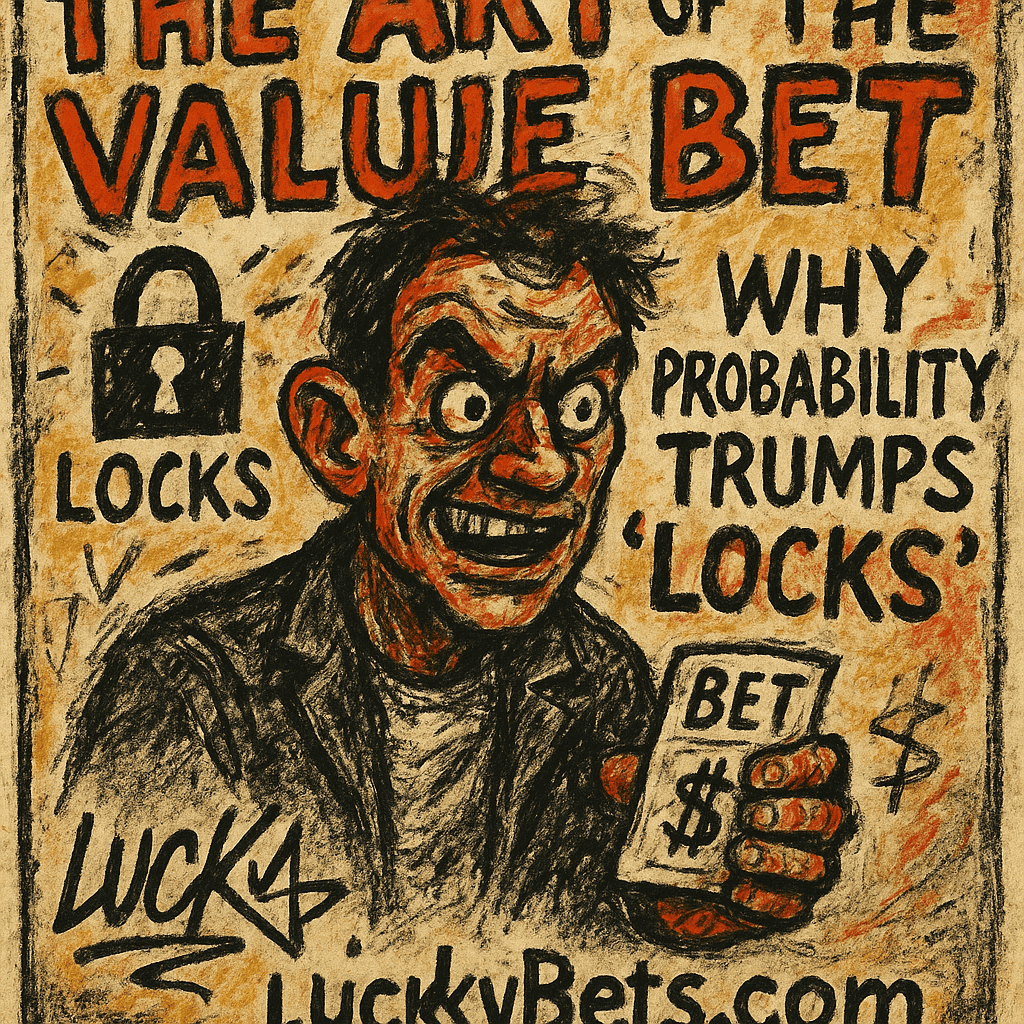
The square bets on the winner. The sharp bets on the price.
LuckyBets.com